

You are wasting time, effort, and money!
And you could be losing good people!
Dig deeper. Do the work. Be ready for what may be multiple causes.
HERE IS ONE WAY…
A Multiple Cause Diagram will:
- Help you untangle your thinking.
- Identify causal relationships.
- Suggest effective points of intervention.
- Shine a light on unintended consequences that might arise if you take inappropriate actions.
And there is even more value:
- Do this as a team.
- Do this with stakeholders.
- It can help explain your thinking to others.
- They in turn can build on your thinking by spotting links you may have overlooked.
- A super-effective tool for collective pictorial dialogue!
- A tool that builds connection and common understanding.
- A tool that help minimise risk and spot opportunities!
SOME SIMPLE RULES…
- Write down the topic in the middle of a large piece of paper (or use software tools).
- Identify what the immediate causes are.
- Write these down, preferably on post-it notes so you can move these around as the picture emerges.
- Use arrows to indicate the direction of causality.
- Go “back” or”down” another level and consider what the causes are of these immediate causes, and so on.
- Consider whether there are any “lateral” connections between the causes.
- Are there any “feedback loops” emerging as a result of these connections? These might suggest effective points for intervention.
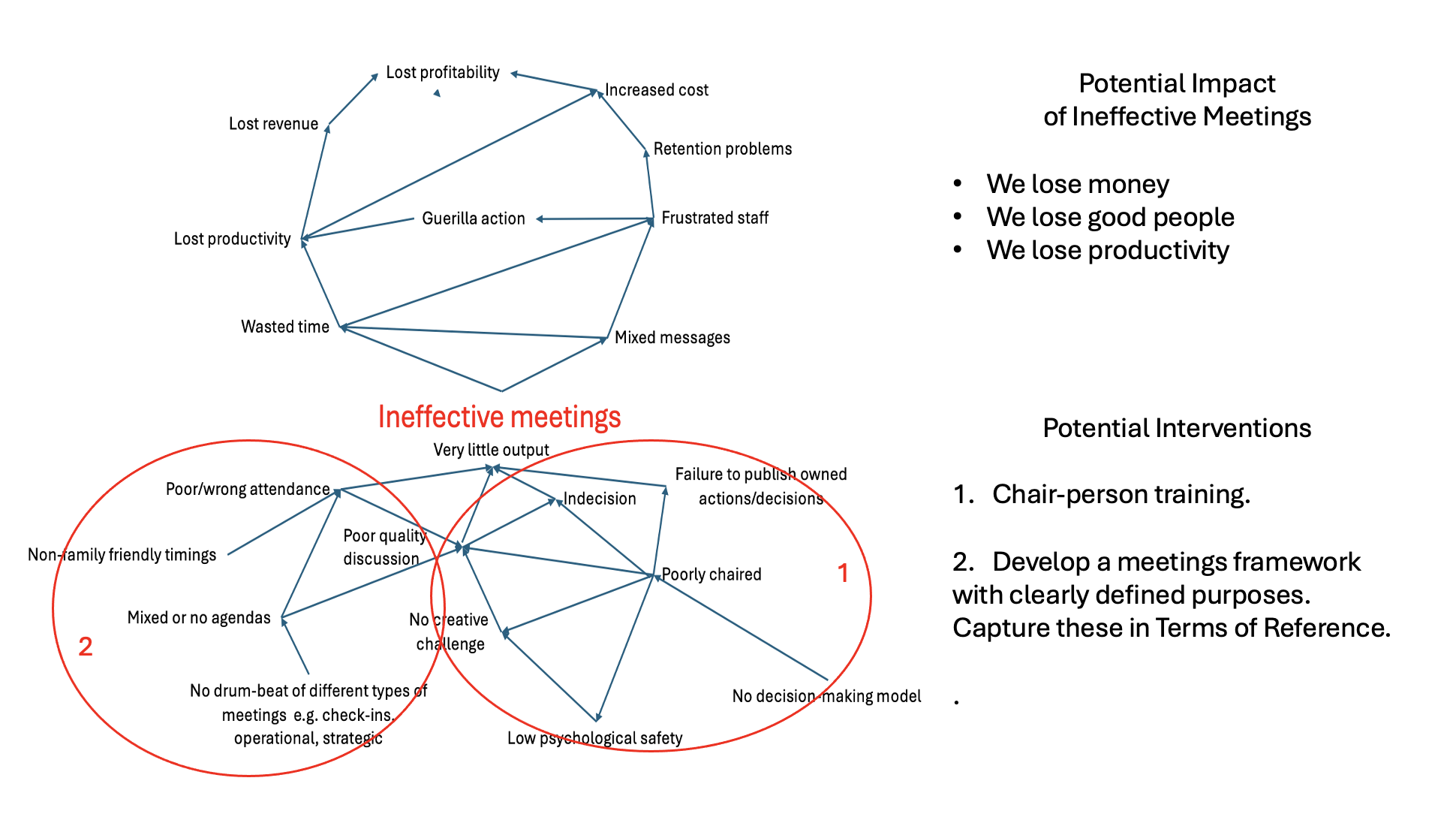
- Are there any groups of causes that taken together could be nailed with a single intervention? See example below.
- Also, consider what the topic itself might be the cause of.
- Use the other half of the paper to do this.
- Repeat. Repeat. Repeat.
AN EXAMPLE…
Meetings are a necessary part of any business. And we have all experienced ineffective meetings. What if we could make things better? Check out this first pass at creating a multiple cause diagram. What would you add or amend?
A NOTE OF CAUTION…
Multiple cause diagrams are not reality. They are a simple high level representation of the world, or system, you and colleagues are experiencing.
But they are a whole load more valuable and helpful than fire-fighting a bunch of symptoms.
You owe it to yourself and your business to give it a go.
Let me know how you get on.
CAN WE HELP YOU? YOU BET WE CAN!
Get in touch now.
Dave Stewart
Founder & Chief Executive
dave@freshairleadership.com
07776 153428
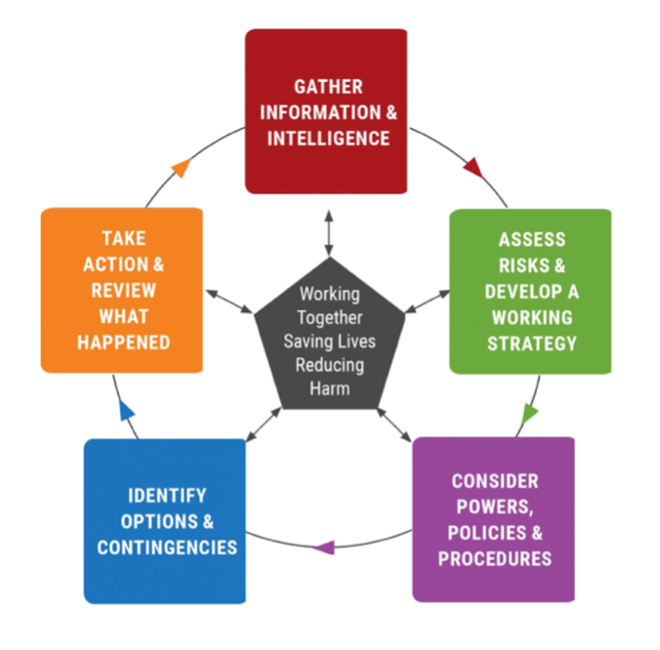 You will note the statement of common purpose in the centre. This acts as a reference point throughout the decision-making process i.e. each step MUST support “Working together. Saving lives. Reducing harm.” So, if waiting to get solid information risks lives, the Emergency Services leaders will press on round “the wheel” and take early action if necessary.