Category Archives: Blog

To collage or to kill?

This is not really about a workshop.

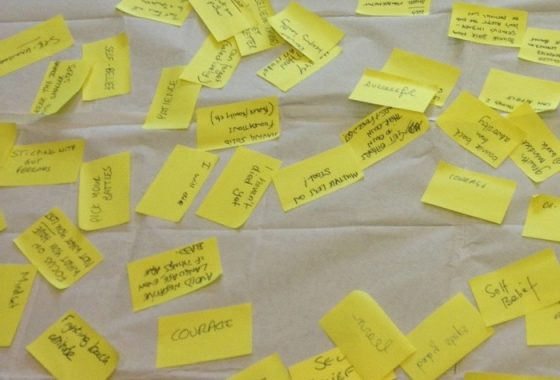
But you can picture the workshop. Lots of stickies. Personal thoughts and views. Lots of them. Scattered and stuck. On background paper.  On personal resilience.

And now the delegates are gathered round ready for the facilitator to help them make
collective sense of their collected individual contributions. This is how workshops run, aren’t they?

Not this time. No effort to group the stickies into themes. No lumping upwards. No attempt to simplify. No handy take-away model.

Instead, an invitation to read out loud the words of others; an invitation to scan the written fragments and make silent, personal sense; an invitation to allow insightful associations to form.

Sure, repeatable processes and simplification are good things. In context.

We just need to be mindful that we are not killing the things we seek; that we are not losing the richness and vitality of people’s lived experience; that we are not sleep-walking into unhelpful habits.

If a simple model is what you need, then group and theme away. If instead you need a portal into a more reflective and creative space then consider playing the collage game. And of course you can use both. And other approaches.

Just be clear about what you really need and be awake when you consider how you might go about getting it. Otherwise you could kill it.

Dave Stewart

The Fresh Air Learning Company

This is not really about a workshop. But you can picture the workshop. Lots of stickies. Personal …

Unflinching selflessness. The disclosure moment.

How important is disclosure where you work? How is disclosure encouraged and enabled? What are the expectations of those around you? Bosses, peers, staff, customers, suppliers?

A friend of mine led an expedition in the Arctic. One team member toughed out the onset of frostbite. Ultimately the whole team, as well as the individual, was put at grave risk when the frostbite deteriorated to the point when there weren’t enough hands, literally, to put up life-saving tents in a -55 degrees Celsius blizzard.

What are the trigger conditions for goal-critical disclosure where you work? The point before which your team really needs to know the important thing you know? The point before which alternatives can be enacted? The point at which colleagues recognise you have done the right thing? The point beyond which problems cost a whole lot more than they need to? The point beyond which people’s respect for you will wither in some way?

How do you balance a desire for individual strength around perseverance and resilience with the needs for team-ship and a focus on collective goals? What are you doing as a team to discuss and define the conditions when unflinching, selfless and courageous conversations are needed? What is the spirit of trust, commitment and accountability that will enable this?

Dave Stewart

The Fresh Air Learning Company

How important is disclosure where you work? How is disclosure encouraged and enabled? What are the expectations …

Talking your way to underperformance

You sense that the other person is about to finish talking. You see a break, and off you go. Your mouth opens and out comes the words you have been itching to say.

How good are you at noticing what you say in meetings? Any conversation really? How well do you rate as a listener?

Do you find yourself waiting your turn to say something you are passionately attached to. Something you have been dying to say for some time? Do you experience an anxious energy which threatens to spill over?

How much of the previous person’s contribution did you actually hear? And were you listening to and reflecting on what they were saying? Did you ask a question to explore and develop new meaning from their ideas? What was created in the exchange?

Or were you, in super-quick fashion, simply categorising the seeming relevance of their contribution without any integration with, or shaping of what you said next? Were you just listening for the gap you are now filling? For your turn?

How creative are the conversations you take part in? What skills are in play? Listening skills, advocacy skills, inquiry skills, self-awareness skills, and more? How are these purposefully developed?

You can reshape strategy. You can redesign your processes. You can play with structures. And you can spend money on tools and apps. These are all good things, and used well, will help your organisation survive and thrive.

At the end of the day however these are all just things that are brought into being as a result of conversations and decisions.

What would it be like where you work if people become more skilled at having great conversations? Can you imagine what that might do for a whole range of issues? Innovation, agility, costs, competitive edge, resilience, engagement etc?

It seems an obvious area to invest in. Not many organisations do. Too busy talking at each other? Too busy talking their way to underperformance.

Dave Stewart

The Fresh Air Learning Company


You sense that the other person is about to finish talking. You see a break, and off …

It’s a no-brainer. It’s a feeling. Do it!

We all know it happens. When times are tough, the training and development budget gets cut first. It is discretionary spend. Or so it is viewed.

Spending is tightly controlled. Closely argued business cases are demanded. The returns have got to look good to justify any investment. And, of course, ROI on training and development is notoriously difficult to quantify.

And yet some companies seem comfortable with allowing emotion and personal experience to sit alongside numerical evidence when they make investment decisions.

“You think we need to roll out a coaching programme across our customer-facing workforce? Yes, do it. No business case. Just tell me how much. We will know when it has worked because we will all feel the difference.”

That was a reported conversation between a well known global company’s Learning & Development Director and the Board.

And there are plenty of other examples like this one coming out of the Chartered Institute for Personnel & Development conference I am attending this week.

I wonder if we now have a generation of leaders who have grown up with positive personal experiences of coaching and mentoring, and who see spend on soft development as a no brainer.

Literally a “no brainer” because this is a decision based on a feeling. A sense of knowing beyond numbers.


Dave Stewart
The Fresh Air Learning Company

We all know it happens. When times are tough, the training and development budget gets cut first. …

Beyond rude and into sloppy!

Getting straight, honest, and clear about the conversations we engage into.

I am pretty clear it is rude and sloppy. Face-to-face or virtually.

You offer a conversation. Someone responds positively. You respond in turn. Then silence. You wait. Maybe try again, worried you weren’t heard; worried the other person is beginning to think you are rude. Again, nothing.

This is an unlikely face-to-face interaction. But why is it so common in the virtual business world?

What is going on when people walk away from a social media or email conversation they have seemingly encouraged? “Thanks for this. Interesting idea/product/blog/point of view. Let’s talk more. Yes, let’s stay in touch over this.” You follow up. Silence.

I am pretty much past worrying, at a personal level, about getting a stiff ignoring. Almost. It still rankles of course. But why are “dead-enders” wasting my time and theirs?

I am genuinely curious about these stalled engagements. What is going on? Where does the initial interest and energy go? Is it a courage thing? Cold-feet around a new relationship, idea etc. Is it an energy thing? “Must get back to the comfort of always doing what I have always done.”

And what about good manners? “Thanks but I need to put this on the back-burner”, or “I have other priorities that demand my attention right now”. How much does a quick reply like that cost?

If we can’t be straight and honest, or find the energy and focus to follow-through, what does this say more widely about the quality of our working and other relationships?

If we just accept that “this is the way it is these days” we are copping out. It is beyond rudeness. It is sloppy and ultimately bad business. I am not promoting the “fluffiness” and niceness of good manners; I am promoting being straight, honest, and clear about what we do with the conversations we engage into. It’s a maturity thing. It is also an effectiveness thing.

So, what could be different right now in the teams and organisations you work in with a bit more social honesty and maturity?

Dave Stewart
The Fresh Air Learning Company


Getting straight, honest, and clear about the conversations we engage into. I am pretty clear it is …

Who gives a blog?

I do. As do others it seems. Let me blog my thoughts on this.

My mentor said I should blog. Establish a tempo of activity and interesting content, and potential clients will find me.

“Tempo” and “interesting”! How would I achieve this?

I was in the wrong head-space from the start. It was as if I was unconsciously carrying an expectation of externally judged excellence. And a fear of falling short. A limiting throwback to school perhaps.

The breakthrough came when I started to frame blogging as an exercise in getting clear about my point of view, or starting a virtual discussion about something I was curious about.

It was about thinking and learning through engagement with myself and with others “out there”. A learning process. Brought to life through the act of writing.

And the more I blog so the back-catalogue grows. A resource to be mined for thoughts on various subjects and themes. A body of evidence to witness my credibility and curiosity in chosen fields. A series of conversations which give shape to my thinking and my business.

And also an attractor. Just as my mentor said. Posting my blogs on Twitter and various LinkedIn groups, I am reaching people who want to engage. Some with the topic, and some with my business. Ultimately blogging is helping me engage into the world of real, physical face-to-face meetings.

So, who gives a blog?

I do. What about you?

Dave Stewart

The Fresh Air Learning Company

I do. As do others it seems. Let me blog my thoughts on this. My mentor said …

Proceed until apprehended!

Blog-46-photo-800x600Have you noticed how some teams forget they were created to serve a higher organisational purpose; that they are instruments of organisational capability; and that ultimately they are “owned” by a sponsor or sponsors?

Sometimes the sponsors have lost sight of their responsibility to govern their teams. Sometimes team leaders are aware of, and take advantage of this loose coupling.

“Proceed until apprehended!” goes the charismatic and courageous cry.

Or are these team leaders just dodging, for whatever reason, an important relationship? And modelling the sort of behaviours they would rather not see in their space?

What is required where you work for team leaders to get senior engagement and direction?

How about upwards leadership through “red ink correction”? Where no written direction exists, write down what you think it should be and then seek comment. The act of writing can be a great way to get clear on issues. And seeking comment from sponsors invites them into a generative, trust building, and clarifying relationship.

Proceeding until apprehended is certainly one strategy. But thinking and engaging upwards in the service of common purpose and unity of effort might be smarter for everyone.

What is going on for teams and sponsors where you work?

Dave Stewart
The Fresh Air Learning Company

Have you noticed how some teams forget they were created to serve a higher organisational purpose; that …